Boys will be boys
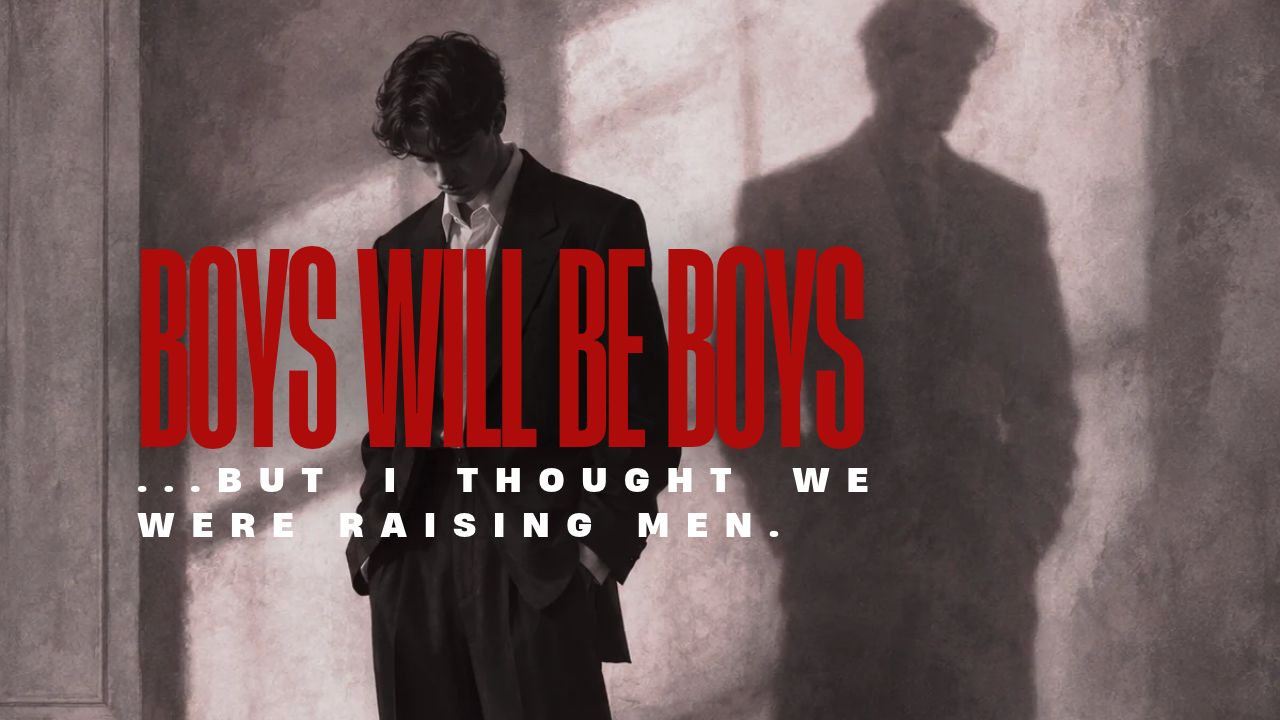
...But I thought we were raising men. I'm sorry, but boys will be better. Boys will grow, boys will mature... and boys will learn that hurting others is never acceptable.
By Lion in a Suit · 6 November 2026 · 8 min read
This is solely an opinion piece. Whether you agree with it or not is honestly none of my concern. This isn't an attempt to connect, find common ground, or be amicable. This is me letting my frustration out — because sometimes, that needs to happen. For me, for you, and for anyone who needs an outlet. Writing happens to be mine.
The Reason
I can't believe that, in 2026, we're still using the incredibly dumb and, quite frankly, juvenile excuse that "boys will be boys."
When will this stop being an acceptable saying? Because, quite honestly, never in my life did I think that my masculinity or my existence as a man was somehow connected to taking advantage of others, particularly women — women who cannot defend themselves, or who cannot freely agree or disagree with something I might ask of them, or, as some prefer to do, merely imply.
Never in my life was I taught that being a man meant taking advantage of others, refusing to grow up, or resisting the need to evolve. Never was I told that behaving worse than a beast would somehow earn me an excuse, let alone dignity or salvation.
And how can these so-called men claim any sort of religious connection or moral standing when they are capable of doing the things they have allegedly done?
You might have guessed the reason behind this opinion piece — or rant, if that's what you prefer to call it. Yes, I'm referring to the infamous Cornell 7.
Seven young men who attended, or have completed their studies at, one of the most prestigious academic institutions in our country and the world. Yet, apparently, basic human decency was nowhere to be found in their education, or perhaps in the lessons they were taught throughout their lives.
I also want to make a brief distinction here. While I stand with Jane Doe, I cannot, at this point, call these individuals criminals, as much as I might want to. A trial lies ahead, and I have to believe in and respect the legal system, including the presumption of innocence. Their alleged actions must therefore remain allegations until the legal process determines otherwise. But please don't mistake my respect for due process as a lack of conviction about where I stand on the issues being discussed.
A group of monsters. Because, honestly, even calling them men feels wrong. But let's not forget that they are, in fact, men, and, sadly, they represent us. Even more sadly, many among us are willing to defend them.
They are part of this preposterous and deeply troubling phenomenon known as the manosphere: a collection of spaces and online communities supposedly created to discuss men's issues, masculinity, and men's relationships with themselves and others.
Yet what could have been an opportunity for meaningful conversations has, in many corners, become a breeding ground for individuals who were apparently never taught some rather basic lessons: that growing up means accepting responsibility for your actions, that mistakes have consequences, that no means no — and nothing else — and that being a man isn't about physical strength. It's about strength of character, the ability to take accountability, and, perhaps most importantly, the willingness to listen to others.
Instead, these so-called men have created spaces where they can gather and rant about all sorts of "important things." (Please understand that everything I'm about to write should be read with the utmost sarcasm.)
Why is everything against me? Why can't I be a man? (Apparently, this means having muscles, owning guns, possessing a handful of lonely brain cells, and being able to hit women and children without facing any repercussions.) Since society isn't on my side, should I simply "decide" not to have sex? (They're called incels, by the way.) How can I pick up women? Why aren't men's rights a thing? Why can't we go back to the good old days? (I'm still not entirely sure which days they're referring to. Is this simply another misogynistic talking point, or does it come with a little racism as well?) And, of course, many more equally "important" questions.
But What Can We Do?
First of all, excuses need to disappear completely, and accountability needs to become more than a hopeful idea. We need to embrace the fact that all parts of humanity matter and deserve to be celebrated. In the end, we're all in this together, whether we like it or not.
There is no reason for anyone to believe they are inherently better than someone else, unless, of course, they are looking for ways to push others below the very definition of what it means to be human.
And this involves all of us. In my anger, I've called these people monsters, but the truth is that they are human beings. An ugly side of humanity, perhaps, but human beings nonetheless. Recognizing that doesn't excuse their behavior or diminish the harm they may have caused. It simply reminds us that we cannot separate ourselves from the responsibility of addressing the darker parts of our own society.
We also need to understand that education happens in many places, not solely in schools or academic institutions. It happens through the media, advertising, online communities, and, of course, at home. We cannot continue playing this endless blame game, pointing fingers at one particular influence every time someone does something wrong. Our environment shapes us, certainly, but we also need to acknowledge that we act out of our own volition. We make choices, whether good or bad, and we must be willing to accept their consequences.
The Male Loneliness Epidemic
Now, let's talk about the so-called male loneliness epidemic.
We really need to dissect and understand this issue, because loneliness among men is real, and it deserves attention. Men should be able to talk about their mental health, their struggles with relationships, their insecurities, and their difficulties connecting with others without being ridiculed or dismissed.
But here's where things become problematic: some individuals who claim to be suffering from this loneliness have turned it into a justification for their hostility toward others. Instead of using these conversations as an opportunity to understand themselves, build meaningful relationships, and improve their own lives, they have used their frustrations to bring others down — women, children, members of the LGBTQ+ community, and yes... other men as well.
And that's where I draw the line. Loneliness is not a license to mistreat others. Rejection is not permission to harass someone. Struggling with intimacy does not entitle anyone to another person's affection, attention, or body.
I've also seen this mentality extend into conversations about OnlyFans and similar platforms. Some men willingly subscribe to creators, spend their money, and then turn around and blame the women on those platforms for the money they've spent or the time they've invested. How does that make any sense? Nobody forced you to subscribe. Nobody made those purchasing decisions for you. You chose to spend your money, and you are responsible for that choice.
I like to remind myself of a simple phrase: "My actions... my consequences."
It's something I try to live by. If something doesn't go my way, I need to look at my own actions and consider what I did or didn't do. That doesn't mean everything that happens to us is our fault, nor does it mean we should blame ourselves for circumstances beyond our control. It means recognizing where our own choices begin and where our responsibility lies.
Perhaps that's something we need to discuss more often when talking about masculinity: taking responsibility for ourselves instead of constantly looking for someone else to blame.
Listen. Just Listen.
Lastly, we need to be willing to truly listen to victims. Not assume they were looking for it. Not question what they were wearing, whether they had been drinking, why they put themselves in that situation, or whether they should have done something differently. These are some of the many excuses and questions we so readily bring up when men are accused of doing horrible things.
And why? Why is our first instinct so often to question the person who might have suffered rather than to listen to what they have to say? It's not that difficult to shut up and listen. Seriously. Just listen.
You might not know how deeply a particular situation affected someone. You might not understand why they reacted the way they did, why they couldn't speak up, or why they couldn't act immediately afterward. Trauma, fear, and the circumstances surrounding an experience are not always visible to those standing on the outside.
We don't need to have experienced something ourselves to acknowledge that someone else has suffered. And we certainly don't need to understand every detail of someone's experience before offering them basic compassion and respect. Sometimes, listening is the most important thing we can do.
A Final Thought
I would like to end with a story for those who still feel the need to question other people's experiences or assume they know better than those who have lived through something themselves.
During the filming of Saruman's death scene in The Lord of the Rings: The Return of the King extended edition, director Peter Jackson began explaining to Sir Christopher Lee how he wanted his character to react and scream after being stabbed in the back by Gríma Wormtongue.
Lee quietly interrupted him and asked: "Have you any idea what kind of noise happens when somebody's stabbed in the back?" He then added: "Because I do." It's a fascinating little moment, and one that I think carries a much bigger lesson.
Sometimes, we believe we know everything about a situation simply because we've read about it, watched it, discussed it, or formed an opinion from a distance. But there's a fundamental difference between imagining an experience and actually living through it. And perhaps that's something we should remember when listening to victims, when discussing masculinity, and when questioning the experiences of others. We don't always know. And sometimes, the best thing we can do is stop talking, start listening, and learn.
Lion in a Suit
I think and I write, that's it. I hope you enjoy the writing and that they offer you some excitement as you discover new things or new angles to look at what you know already.
Read next

Fashion · Opinion
Art meets fashion: "Drawing Prada: Animated by Hand"
When true art, crafted by hand, becomes increasingly rare in the age of AI, many brands are quick to follow the latest trends. But some understand that classics never go out of style. Prada seems to have done just that.
Lion in a Suit · 5 November 2026 · 2 min

Fashion · Opinion
Review: Chelsea Boots by Octobre Éditions
Chelsea boots are a type of footwear that I believe we should all have as an option in our wardrobes. If you don't own a pair already, I hope this review encourages you to consider looking into them.
★ 9.5 · Classic
Lion in a Suit · 3 November 2026 · 3 min

World · Opinion
Must Eat: Artesano
If you're looking for something different, delicious, and worth discovering, then Artesano, in New York City's Tribeca neighborhood, should definitely be on your radar.
★ 10.0 · Worth a Detour
Lion in a Suit · 2 November 2026 · 4 min